Mérida offers one of Spain’s clearest opportunities to understand a Roman city through connected public buildings. The theatre, amphitheatre and National Museum of Roman Art should be visited as one conversation about spectacle, engineering and daily life rather than three unrelated attractions.
QUICK VERDICT
Pair the archaeological complex with the museum
The ruins establish scale; the museum supplies objects, construction logic and urban context. Visiting both produces a much stronger understanding than seeing the theatre alone.
At a glance
- Best for: Roman urbanism, performance architecture and archaeological collections
- Time needed: One full day; two days for the wider Roman city
- Plan first: Check monument and museum closing days, seasonal hours and combined tickets
Architecture and landmarks at a glance
| Landmark | What to notice | Planning approach |
|---|---|---|
| Roman Theatre | Stage façade, seating hierarchy and performance space | Visit early and check festival restrictions |
| Amphitheatre | Arena, circulation and spectacle architecture | See it immediately before or after the theatre |
| National Museum of Roman Art | Rafael Moneo’s brick architecture and major collections | Allow at least ninety minutes and verify its separate schedule |
The theatre was designed for both sight and status
The semicircular seating focused attention on a richly articulated stage building. Columns, niches and statuary created an architectural image of civic order behind the performers.
Move through the site slowly and compare views from different seating levels. Modern festival infrastructure may be visible because the monument remains a performance venue.
The amphitheatre tells a different story
Next door, the amphitheatre organized spectators around an arena rather than a stage. Entrances, service spaces and seating divisions reveal how large crowds were separated and moved.
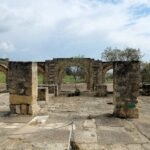
The surviving fabric is less theatrical than the reconstructed theatre image, but that makes close reading important. Look at circulation before concentrating on the arena floor.
Recommended experiences
See guided visits and ticket options
Compare current tours, entry options and meeting points, then read the supplier conditions before booking.
Affiliate booking: GoTripSteps may earn a commission if you book, at no extra cost to you. Availability and prices are supplied by GetYourGuide.
The museum is architecture as interpretation
Rafael Moneo’s museum uses monumental brick arches and controlled daylight to evoke Roman construction without copying an ancient building. The architecture sets scale for mosaics, sculpture and everyday objects.
Visit after the main ruins if possible. Objects then answer questions raised outdoors, and models help reconstruct the city beyond the surviving walls.
Build a wider Roman itinerary
Mérida also preserves an aqueduct, bridge, temple, circus and domestic sites. A second day turns individual monuments into a legible urban network.
Summer heat can be intense, so place exposed archaeology in cooler hours and the museum in the middle of the day. Carry water and use shade whenever available.
Practical checklist
- Confirm both archaeological and museum schedules.
- Use cooler morning hours for exposed sites.
- Check whether performances alter theatre access.
- Keep the same ticket until all included monuments are complete.
Frequently asked questions
Are the Roman Theatre and Amphitheatre on one ticket?
They are commonly part of the main archaeological visit, but ticket structures can change. Confirm the current official options.
Is Mérida worth visiting without a car?
Yes. Many central monuments are walkable. A car is more useful for a broader Extremadura road trip.
When is the best time to visit?
Spring and autumn are comfortable. In summer, begin outdoor sites early and use museums during the hottest hours.
Continue planning your Spain trip
Cáceres architecture guide · Train or rental-car planning · Southern Spain transport ideas
Opening hours, access rules, restoration work and ticket conditions can change. Check the monument or city tourism website shortly before your visit.
Planning reference: Mérida Tourism — Fees and Hours.
Featured photograph: Mimi-chan / Wikimedia Commons (Public domain).