Puerta del Sol is Madrid’s symbolic centre: a pedestrian square where Spain’s road network begins, New Year’s Eve is counted down on a 19th-century clock, and some of the capital’s best-known monuments stand within a few minutes of traditional pastry shops and historic taverns. This guide explains what each landmark means, how to see the square efficiently, where to eat nearby, and how to continue on foot to Plaza Mayor and Madrid de los Austrias. For a wider city overview, start with our Madrid guide for first-time visitors.

Why Puerta del Sol matters
Puerta del Sol is not simply a convenient square between Gran Vía and Plaza Mayor. It grew from an eastern gateway in Madrid’s old defensive wall. A sun once decorated that gate, giving the place its name — the “Gate of the Sun”. As the city expanded, the entrance disappeared and the surrounding space evolved into a transport, commercial and political centre.
Today, ten streets feed into the square, including Calle Mayor, Calle del Arenal, Calle de Alcalá, Carrera de San Jerónimo, Calle de Preciados and Calle de Montera. The modern plaza is fully pedestrianised, making it a natural starting point for exploring central Madrid on foot. Its symbolic importance comes from several layers of history occupying the same compact space: royal urban reform, the national road network, political events, popular meeting places and Spain’s best-known New Year’s Eve tradition.
The most useful way to visit is not to rush across the plaza. Walk around its perimeter once, then cross the open centre. From different angles you will notice the Real Casa de Correos clock, the Kilometre Zero plaque, the Bear and Strawberry Tree, the statues of Charles III and Mariblanca, and the rooftop Tío Pepe sign.
The essential Puerta del Sol landmarks
1. Real Casa de Correos and the New Year’s Eve clock
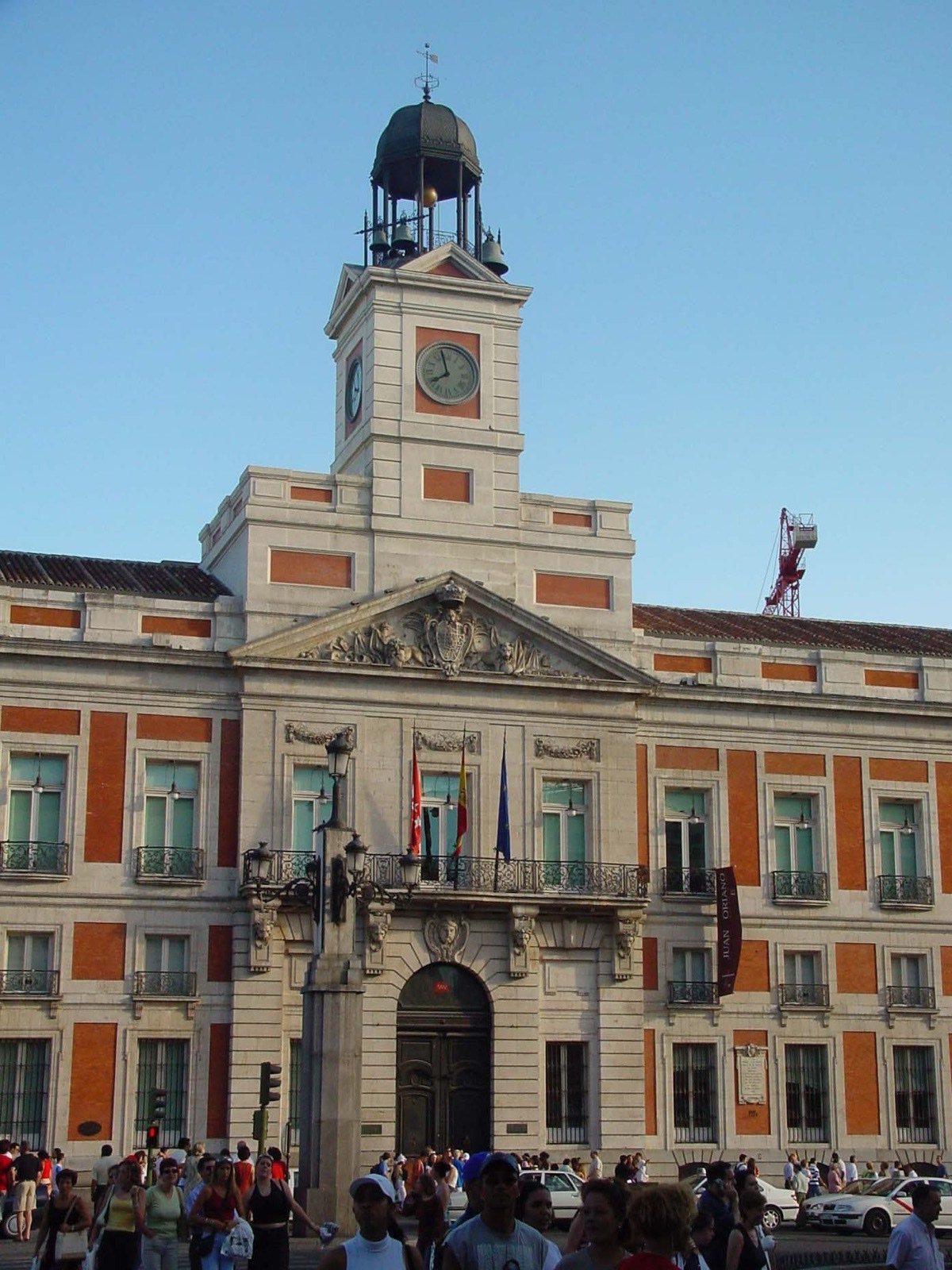
The red-and-white Real Casa de Correos is the square’s oldest surviving building and its visual anchor. It was constructed between 1756 and 1768 as Madrid’s central post office. The project began under Fernando VI, and Charles III later entrusted it to the architect Jaime Marquet. The building now houses the Presidency of the Community of Madrid.
Its clock was made by José Rodríguez Losada and inaugurated in 1866. Each 31 December, millions of people watch its twelve midnight chimes and eat one grape with each chime — the Spanish tradition known as las doce uvas. If you visit around New Year’s Eve, expect security controls, limited capacity and temporary transport changes; check official Madrid information before travelling.
2. Kilometre Zero: where Spain’s radial roads begin
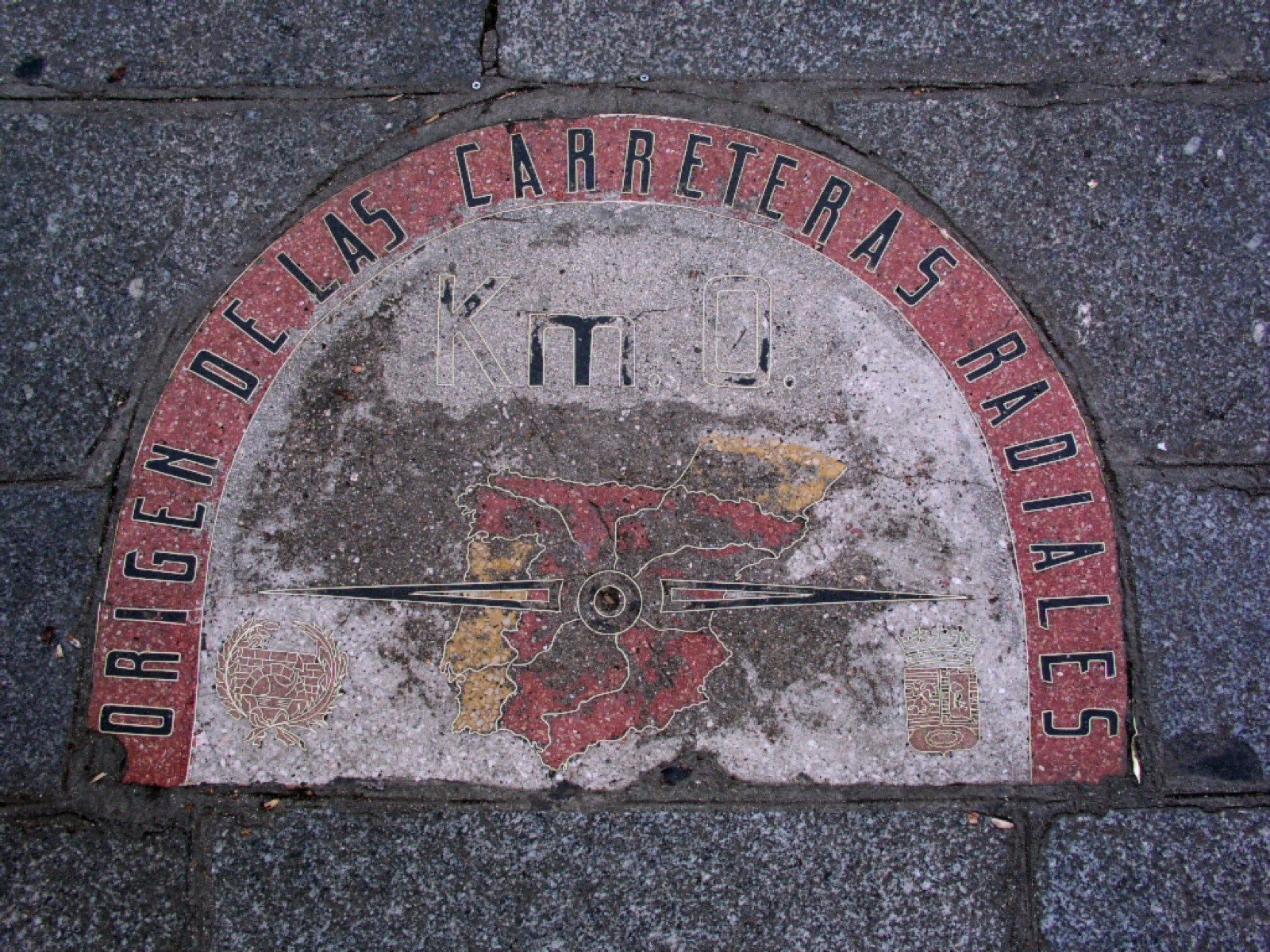
Look down at the pavement directly in front of the main entrance to the Real Casa de Correos. The stone plaque marked Km. 0 identifies the traditional starting point of Spain’s radial national roads. Madrid was defined as the road network’s Kilometre Zero in 1854, while the first official pavement plaque was installed in 1950.
The plaque is easy to miss when the square is crowded. Stand facing the clock, move towards the building’s central doorway, and watch for the semicircle of visitors taking photographs at their feet. Early morning is the easiest time for an unobstructed view.
3. El Oso y el Madroño: Madrid’s best-known symbol
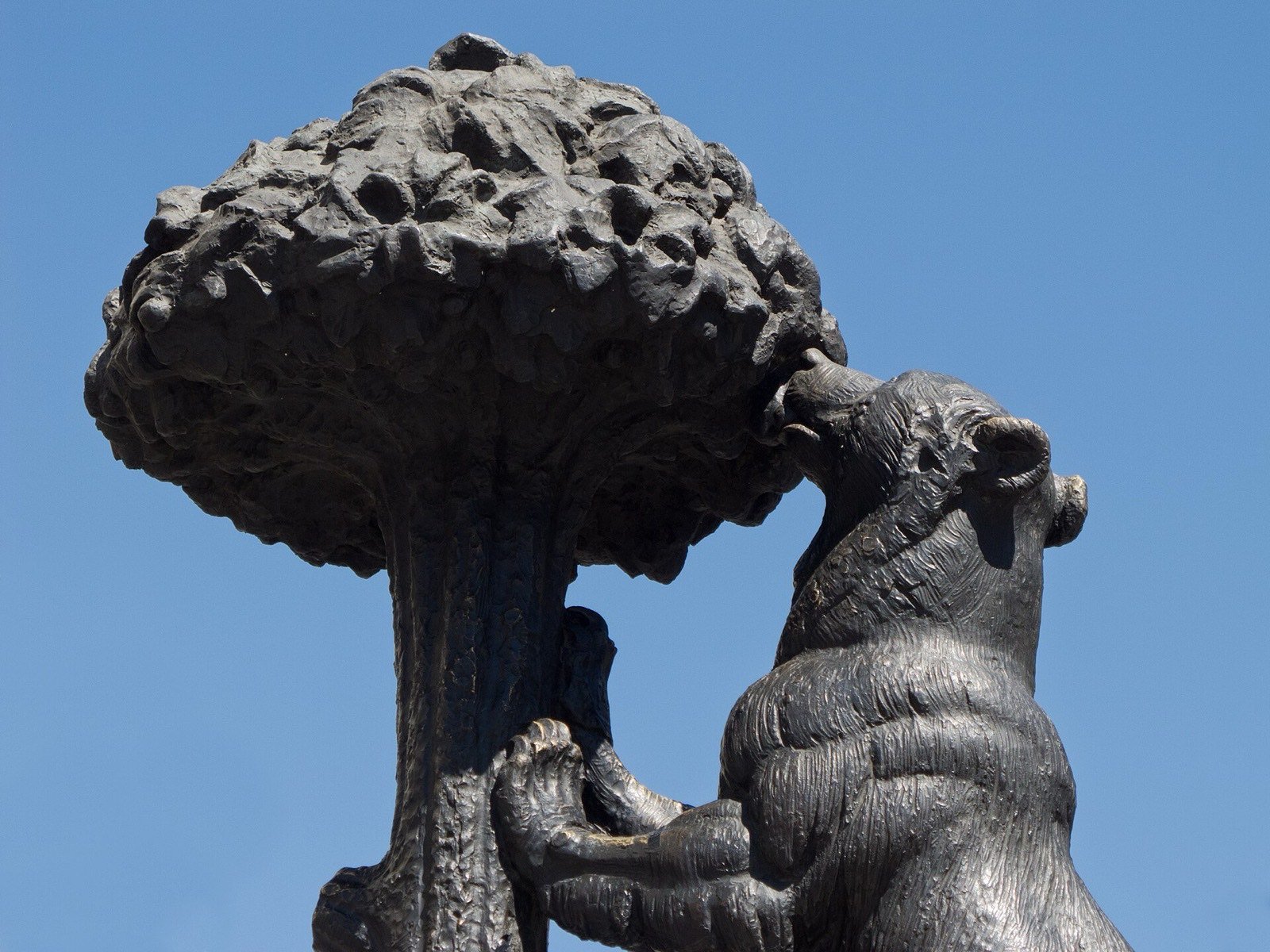
At the Calle de Alcalá side of the square, the bronze Bear and Strawberry Tree represents the emblem on Madrid’s coat of arms. Sculptor Antonio Navarro Santafé created the monument in 1966, and it was inaugurated in 1967. It has become one of the city’s most familiar meeting points — “meet me at the bear” is far clearer than trying to describe an exit from busy Sol station.
The animal is traditionally described as a bear, although the heraldic figure has changed across centuries. The madroño is the strawberry tree, an evergreen Mediterranean species whose red fruit appears on Madrid’s emblem.
4. The equestrian statue of Charles III
The large bronze equestrian statue honours King Charles III, the 18th-century monarch remembered for major urban improvements in Madrid. His reforms to lighting, sanitation, roads and monumental architecture led to the popular description of him as “Madrid’s best mayor”.
The sculpture is a useful orientation point in the open centre of the plaza. From here, turn towards the clock for the Real Casa de Correos, towards Calle de Alcalá for the Bear and Strawberry Tree, or towards Calle del Arenal for Mariblanca and the route to San Ginés.
5. Mariblanca
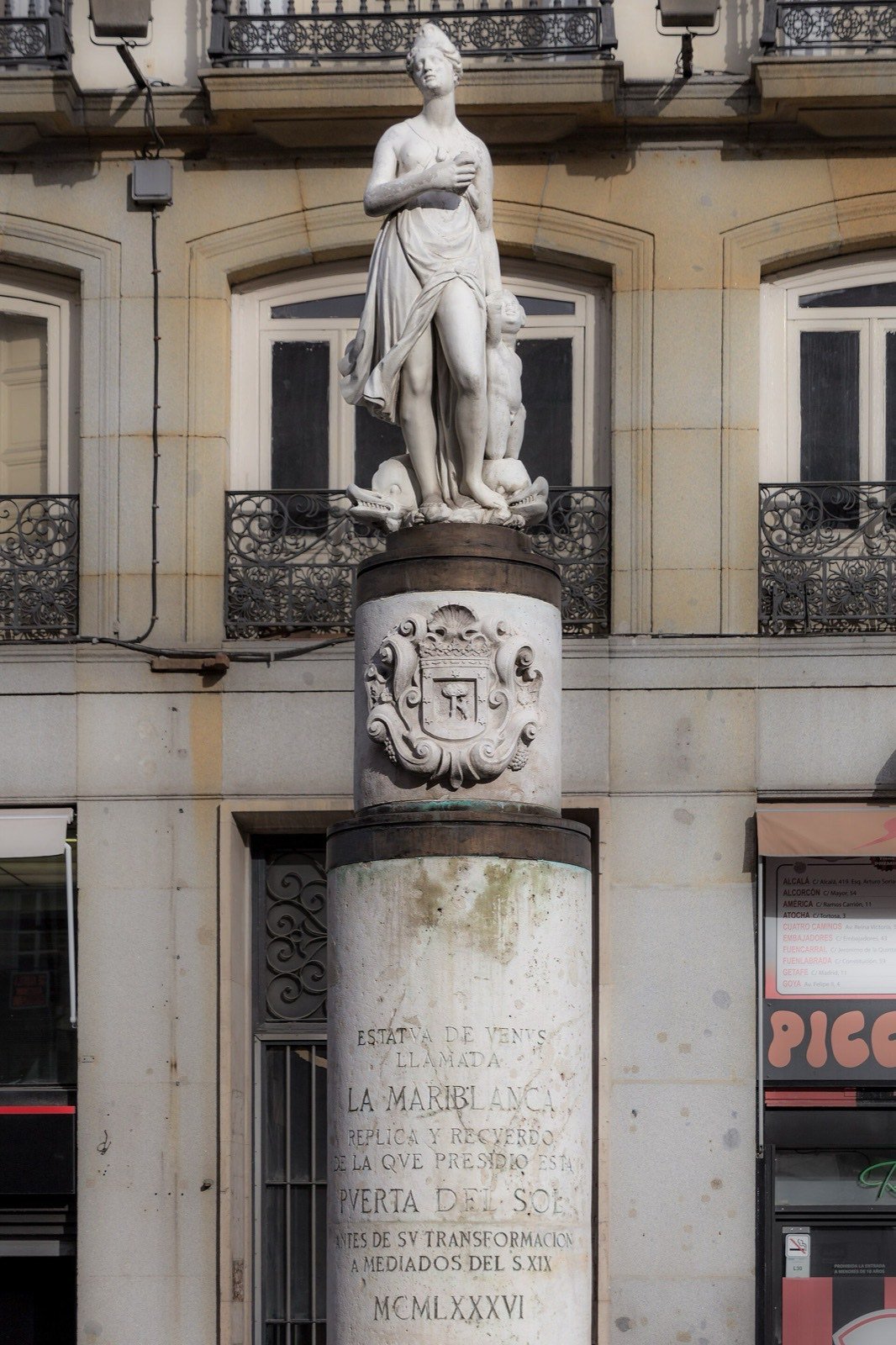
Near the entrance to Calle del Arenal stands a pale stone figure known as Mariblanca. The statue on the square is a replica, installed in 1986, of a 17th-century figure that once crowned a fountain in Puerta del Sol. The original is preserved in Casa de la Villa.
Mariblanca is quieter and less frequently photographed than the bear, but it tells an important part of the square’s earlier story. From this side of Sol, Calle del Arenal leads west towards the Church of San Ginés, Chocolatería San Ginés, Teatro Real and the Royal Palace.
6. The Tío Pepe rooftop sign
Look above building number 11 for the illuminated Tío Pepe sign. Created as an advertisement for a Jerez sherry brand, it became part of Madrid’s protected urban identity and is now treated as a historic sign rather than ordinary rooftop advertising. Its bottle-shaped figure, red jacket and guitar are especially striking after dark.
The sign originally occupied another building on the square and returned to Puerta del Sol at its present location after restoration. It is a useful reminder that the visual history of Sol includes not only monuments and government buildings but also the commercial culture of 20th-century Madrid.
Puerta del Sol map and a 60–90 minute self-guided walk
- Start at Sol station’s main entrance. Pause in the centre for a wide view of the semicircular plaza and the Charles III statue.
- Walk to El Oso y el Madroño. Allow five minutes for the monument and the view along Calle de Alcalá.
- Cross to the Real Casa de Correos. Look up at the clock, then find Kilometre Zero in the pavement.
- Continue towards Mariblanca and Calle del Arenal. Look back across the square for the Tío Pepe sign.
- Make a food stop. Choose Casa Labra for cod croquettes, La Mallorquina for a pastry, or continue to San Ginés for churros.
- Extend the walk to Plaza Mayor. From Calle Mayor, Plaza Mayor is roughly eight minutes away; Mercado de San Miguel and the old streets of Madrid de los Austrias are immediately beyond it.
Where to eat near Puerta del Sol
The streets around Sol contain many fast-food chains and tourist menus, but several historic Madrid businesses are also within an easy walk. The places below are included for their cultural relevance, long-standing specialities and convenient location — not as paid placements. Opening hours, menus and reservation rules can change, so check the linked official website before visiting.
| Place | Walk from Sol | Best for | Relative price | Address |
|---|---|---|---|---|
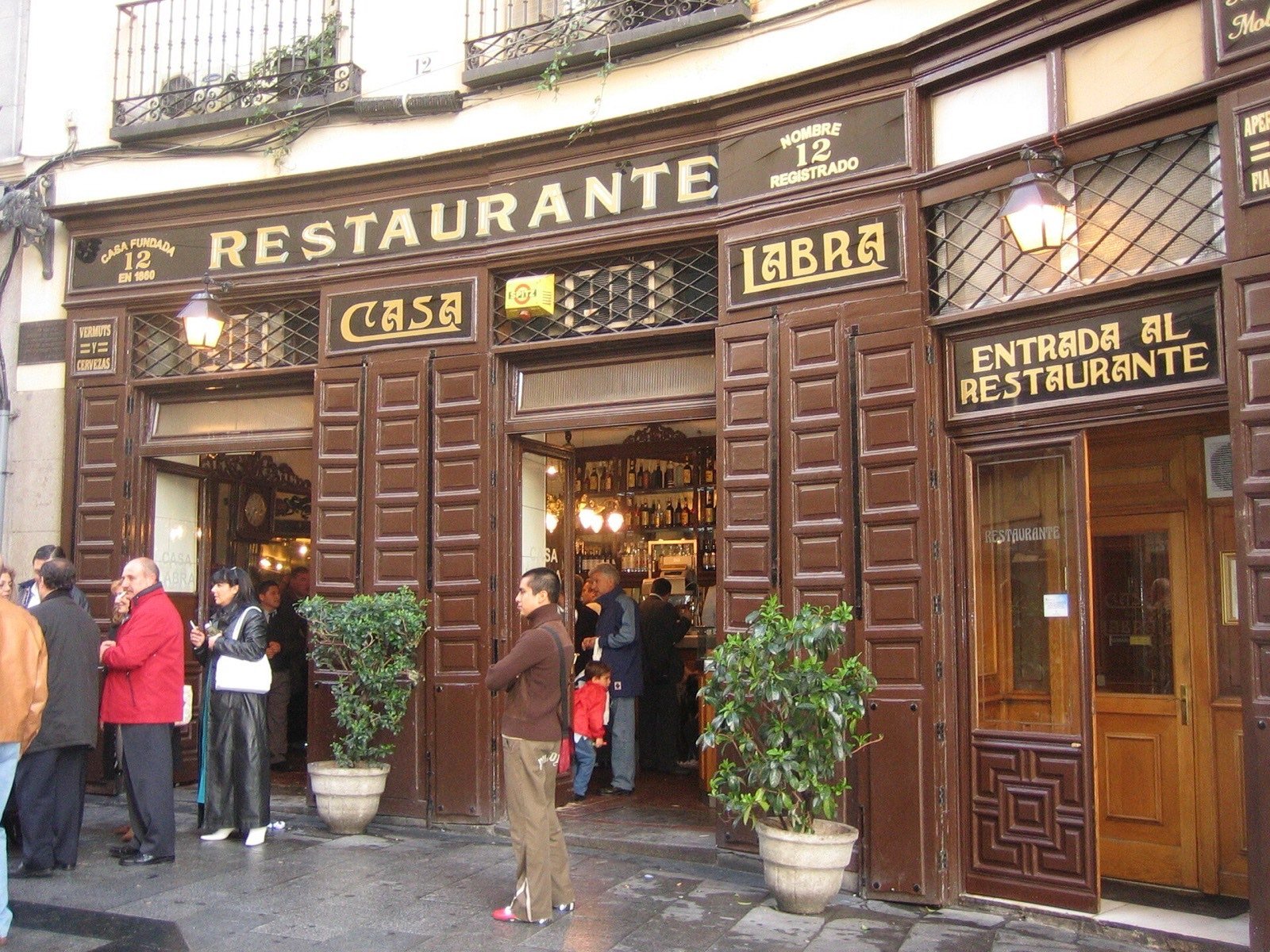
| Casa Labra | 2–3 minutes | Cod croquettes and fried cod in a historic standing-room tavern | € | Calle de Tetuán, 12 |
| La Mallorquina | 1 minute | Breakfast, napolitana de crema, pastries and coffee | € | Calle Mayor, 2 / Puerta del Sol |
| Lhardy | 3–4 minutes | Formal historic dining, cocido madrileño and classic service | €€€ | Carrera de San Jerónimo, 8 |
| Chocolatería San Ginés | 5–6 minutes | Hot chocolate with churros in a Madrid institution founded in 1894 | € | Pasadizo de San Ginés, 5 |
| Restaurante Botín | 9–10 minutes | Traditional roast suckling pig or lamb in a restaurant founded in 1725 | €€€ | Calle de Cuchilleros, 17 |
Casa Labra: the quickest traditional stop
Casa Labra opened in 1860 and is famous for cod croquettes and pieces of fried battered cod. The classic experience is brief and informal: order at the counter, find standing space and pair the cod with a small beer or soft drink. The tavern is also historically significant because the Spanish Socialist Workers’ Party was founded there clandestinely in 1879.
Which food stop should you choose?
- For a quick savoury snack: Casa Labra.
- For breakfast or a pastry without leaving the square: La Mallorquina.
- For a traditional sit-down meal: Lhardy.
- For a late-night Madrid classic: Chocolatería San Ginés.
- For a destination restaurant near Plaza Mayor: Botín — reserve ahead.
Practical information for visiting Puerta del Sol
How to get there
Metro: Sol station is served by lines 1, 2 and 3. Cercanías: Sol connects with C-3 and C-4 services, making it convenient from Atocha and Chamartín. The station is accessible and has lift access. Walking is usually the simplest option if you are already in Centro: Gran Vía, Plaza Mayor, Plaza de Santa Ana and Ópera are all close. Arriving by air? Compare the routes in our Madrid Airport to the city centre guide.
When to visit
- Early morning: best for photographs and seeing Kilometre Zero without a crowd.
- Late afternoon: combine the square with shopping on Preciados or a walk to Plaza Mayor.
- After sunset: best for the illuminated clock and Tío Pepe sign.
- New Year’s Eve: culturally memorable but extremely crowded and controlled; it is not the best time for ordinary sightseeing.
Accessibility
Puerta del Sol is pedestrianised and has a largely uniform, step-free paved surface. Madrid’s official accessibility guide notes lift access from the Metro and guide strips along principal routes for visitors with visual impairments. Crowds are the main practical obstacle, so early morning is preferable for visitors who need more space or a slower pace.
Safety and visitor etiquette
Sol is busy from morning until late at night. Keep phones, passports and wallets secure in dense crowds, especially around station entrances and street performances. Use official ticket channels for tours and transport. Photograph monuments without blocking doorways or the Kilometre Zero plaque, and remember that the Real Casa de Correos is a working government building rather than a general walk-in attraction.
What to see near Puerta del Sol
Puerta del Sol works best as the centre of a larger walking route. These approximate walking times begin in the square:
- Plaza Mayor — 8 minutes: Madrid’s arcaded ceremonial square.
- Mercado de San Miguel — 9 minutes: an iron-and-glass food market beside Plaza Mayor.
- Gran Vía — 8 minutes: theatres, early-20th-century architecture and shopping.
- Plaza de Santa Ana — 8 minutes: literary Madrid, terraces and the Teatro Español.
- Teatro Real and Plaza de Oriente — 11–13 minutes: opera-house architecture and views towards the Royal Palace.
- Royal Palace of Madrid — 15 minutes: allow a separate timed visit rather than treating it as a quick stop.
A logical half-day route is Puerta del Sol → Plaza Mayor → Mercado de San Miguel → Madrid de los Austrias → Royal Palace. For a different atmosphere, walk east from Sol along Carrera de San Jerónimo towards Plaza de Canalejas, the Congress of Deputies and the Prado area. If you are planning an evening nearby, our Madrid flamenco guide explains how to compare tablaos, tickets and seating.
Frequently asked questions
Is Puerta del Sol free to visit?
Yes. Puerta del Sol is a public square and all of the outdoor landmarks in this guide can be seen free of charge.
How much time do you need at Puerta del Sol?
Allow 45–60 minutes to identify the main landmarks without rushing. Allow two to three hours if you add a restaurant stop, Plaza Mayor and Mercado de San Miguel.
Where exactly is Kilometre Zero?
It is set into the pavement in front of the central entrance to the Real Casa de Correos, directly beneath the famous clock.
What is the most famous statue in Puerta del Sol?
El Oso y el Madroño — the Bear and Strawberry Tree — is Madrid’s heraldic symbol and the square’s most popular meeting point. The equestrian statue of Charles III is larger and occupies the central area.
What happens at Puerta del Sol on New Year’s Eve?
At midnight, people eat twelve grapes in time with the twelve chimes of the Real Casa de Correos clock. The event is broadcast across Spain and the square operates with strict crowd controls.
What is the best traditional food near Puerta del Sol?
For a quick local stop, try cod croquettes or fried cod at Casa Labra. For sweets, La Mallorquina and Chocolatería San Ginés are the classic nearby choices. Lhardy offers a more formal traditional meal.
Is Puerta del Sol accessible for wheelchair users?
The square is pedestrianised and step-free with a largely uniform paved surface. Sol station has lift access. Heavy crowds can reduce manoeuvring space, so early morning is the easiest time to visit.
Is Puerta del Sol the geographical centre of Spain?
It is the symbolic origin of Spain’s radial road network, marked by the Kilometre Zero plaque. It should not be confused with a scientific calculation of the country’s geographical centre.